
ALL THAT GLISTERS IS NOT GOLD
The years 1890 to 1893 had been a period of world-wide, economic depression. In Australia the situation reached crisis point when the Commercial Bank of Australia suspended trading in April 1893. A dozen other banks failed soon afterwards. Amid this widespread ruin the thriving gold mining town of Parkes, in the central west of New South Wales, offered a rare opportunity for brave souls with a little capital.
Thanks to the success of his colleges, George Ratten was just such a person.
In 1873 Parkes (formerly known as Currajong) had been renamed in honour of the Premier of NSW, Sir Henry Parkes. Initially founded due its abundance of kurrajong trees, the town had grown considerably during the gold rush of the 1870s. In December 1893 the railway line from Sydney was extended from Molong to Parkes and neighbouring Forbes. This opened the region up, with farmers enjoying far better access to markets. George Ratten would also have been attracted by reports that the new Bushman’s Hill mine was producing astonishing quantities of gold. Prosperity was virtually guaranteed.
Parkes presented an intoxicating environment for the adolescent Victor Ratten. He understood that to succeed in life it was sometimes necessary to take risks. Shares in a mine that stuck gold could suddenly make a poor man rich
Gold was also part of Ratten family mythology. In 1842, at the age of eight, George’s father Richard had emigrated from Kent with several older siblings. When the Victorian gold rush began in 1851, Richard was among those to strike it rich. A year later he purchased 750 acres of land in Cotham Road, Kew, where he married and raised a family. Many years later his son Frederick (Victor’s uncle) would serve as Mayor of Kew, by then one of Melbourne’s most exclusive suburbs.
After arriving in Parkes, George Ratten made a substantial investment, an indication that he intended the move to be permanent. He purchased land from storekeeper Robert Thomas, a longtime resident who had been instrumental in persuading the government to bring the rail line to Parkes. On this block George built a residence for his family, and beside it a private school known variously as College House or Parkes College. It was a large, single storey brick building, with a deep verandah running along the front. The college was located near the showgrounds in Mitchell Street, then on the outskirts of town.
George Ratten’s plan was to educate the offspring of wealthy graziers, and local businessmen, preparing them for university or careers in commerce. He must have been delighted with his decision to move to Parkes when, on October 1 1894, the Western Champion newspaper reported on the Bushman’s Mine’s latest ‘crushing. From 441 tons of quartz, enough gold was extracted to make a ‘cake’ weighing 1,349 oz and valued at 4,800 pounds. It was lodged at the local Bank of Australasia, where the public flocked to see it.
That extraordinary yield of gold coincided with a second visit to the town by Sir Henry Parkes in October 1894. The elderly statesman was accompanied by Lady Parkes and their young son Cobden. George Ratten was always ready to seize an opportunity, and somehow he managed to arrange for Sir Henry to officially open the college on Monday, October 8. A photograph taken of the occasion shows Victor’s proud father standing in cap and gown beside Sir Henry. Lady Parkes is pictured with Mrs Ratten. They are surrounded by some twenty five students. Presumably Victor and his siblings were among, them, although they are not identified. It was an auspicious beginning for George’s new venture.

The auspicious opening of the college by Sir Henry Parkes.

The old Parkes College is now a private residence.
The Bushman’s Hill gold cake was duly viewed by the Parkes family and named ‘The Lady Parkes.’ Sir Henry also gave several lectures during his visit, the most significant being titled; Australian Union as the Crowning of Australian Freedom. When the Australian States finally did unite in 1901, Sir Henry became known as the Father of Federation.

Sir Henry and Lady Parkes and their son Cobram inspecting the Bushman’s Mine gold cake, surrounded by local dignitaries.
As Christmas and the end of the school year approached, George Ratten organized the college’s first speech night .It was quite a production, held in the town’s Royal Hall on December 20. An impressive programme was printed and circulated; all good publicity. And who topped the bill? Young Victor of course. He took the leading role of King Formosus in the play, Magic Glass. He and his brothers Frederick and Aubrey appeared in various other sketches on the bill. Their little sisters and other junior pupils took part in charades.
A REVERSAL OF FORTUNE
Gold fever leads to fevers of a different nature, especially as unsanitary shanty towns tend to spring up around mining sites. In Parkes there was also concern due to Chinese market gardeners establishing a settlement on the area around the town’s water supply. In February 1895, after failing to comply with an eviction order, the Chinese were ejected by police constables and the bailiff. There was no compensation and one old man was so distraught that he tried to strangle himself with a rope. When he was forcibly prevented from doing so the poor fellow began smashing his skull on a log.
If town councilors thought the threat of disease had been removed along with the hapless Chinese they were wrong. The summer of 1895/6 was intensely hot and dry in the Parkes area. In mid January there were five heat-related deaths in a single day. Animals were dying and there were complaints that the carcasses were being left to rot in the streets. A report from the town published in the National Advocate read; ‘The outlook for farmers and graziers is desperate. Stock is perishing everywhere.’ At nearby Forbes there were several cases of typhoid, and the fear was that it would spread to Parkes. George Ratten must have reflected on the fresh sea breezes of Port Fairy and questioned his decision to move his family.
Sure enough, by the autumn of 1896 there was a typhoid epidemic in the town. There were serious implications for George Ratten’s college, particularly as most of the sufferers were under the age of twenty By April there were 100 cases and the local hospital was completely overwhelmed. Funds ran out and a subscription had to be taken up to allow the institution to continue treating patients. Several people were dying from the disease every day. The cause was said to be unsanitary cesspits, and the fact that people were burying the excreta of fever patients in their backyards. Contamination occurred when bacteria infected dust accumulated on roofs then found its way into domestic water tanks during rare periods of rain.
At the very peak of the epidemic, on April 27, old Henry Parkes died of heart failure in Sydney, aged 81. If George Ratten perceived this death as an unpleasant omen, he was right.
Meanwhile, Victor was immersed in the final year of his studies. In such a small college he had the benefit of almost one-to-one tuition. He was an engaged student, particularly when an astute maths master tied a problem to the game of cricket, one of Victor’s passions.
AN INTERESTING PROBLEM
V.R. Ratten writes to us from Parkes College, Parkes, as follows: ‘One of our masters has given us an algebraical question, the answer to which may be both interesting and astonishing to many of your readers, The question is as follows; Out of the fourteen cricketers that went home to England lately, in how many ways can an eleven be chosen? The answer is 364. I append the full workings below, which can be verified on reference to Hall and Knight’s ‘Higher Algebra’, page 119 (Permutations and combinations.)
Unfortunately it seems that the wrong eleven was selected. England, captained by the formidable W.C. Grace, won the series 2-1.
In May 1896 Victor and his younger brother travelled to Forbes, to sit important, public examinations. They were held at the town hall, supervised by a committee of local worthies. For Victor, hoping to go on to university, it was the Junior Public Examination. Fred was destined for the Civil Service.
By now there had been a severe reversal of fortune for the Bushman’s Mine at Parkes.. It was not lack of gold that created the problem, but the eternal problem of drought. Without water, crushing of the gold bearing stone could not continue. Shareholders had scoffed at offers of 60,000 pounds for the business in 1895, but the highest bid offered at public auction in 1898 was a paltry 1,625. One pundit commented that the auction result signaled, ‘… the downfall of the New Bushman’s Mine, Parkes, and with it the shattering of hopes that once ran high.’ The viability of College House, was so badly affected that it closed its doors even before the end of the school year, in September 1897
Whether Victor did well in his public examination is unknown, but irrelevant. There was simply no money to send him to university. Nevertheless, his parents had provided him with a good education and all the social accomplishments befitting a young gentleman. He had an enquiring mind and a fierce determination to succeed. Nevertheless, his options were limited. He moved twenty miles south to Forbes, another old gold town, and took a job with the Union Bank. His brother Frederick was employed in the same bank at Parkes.
After its heady gold mining era in the 1860s Forbes had become a quiet country town, but old-timers still spoke about its connection with bushranger Ben Hall. He was shot dead by troopers at nearby Billabong Creek in 1865. and buried in Forbes cemetery. Strangely enough, Ned Kelly’s sister Kate lived in the town during Victor’s time, and worked as a domestic at the Albion Hotel before marrying a respectable local blacksmith . Like Ben Hall, Kate Foster (nee Kelly) was buried in the town’s cemetery. Old-timers suggested she drowned in Forbes Lake in 1898, while trying to save the life of an Aboriginal child during a flood, but the accepted story is that she took her own life.
The Ratten boys were soon making their mark as sportsmen. Victor was involved in competitive cycling, tennis and rugby. He played for the Forbes football team when it won the 1897 district premiership.
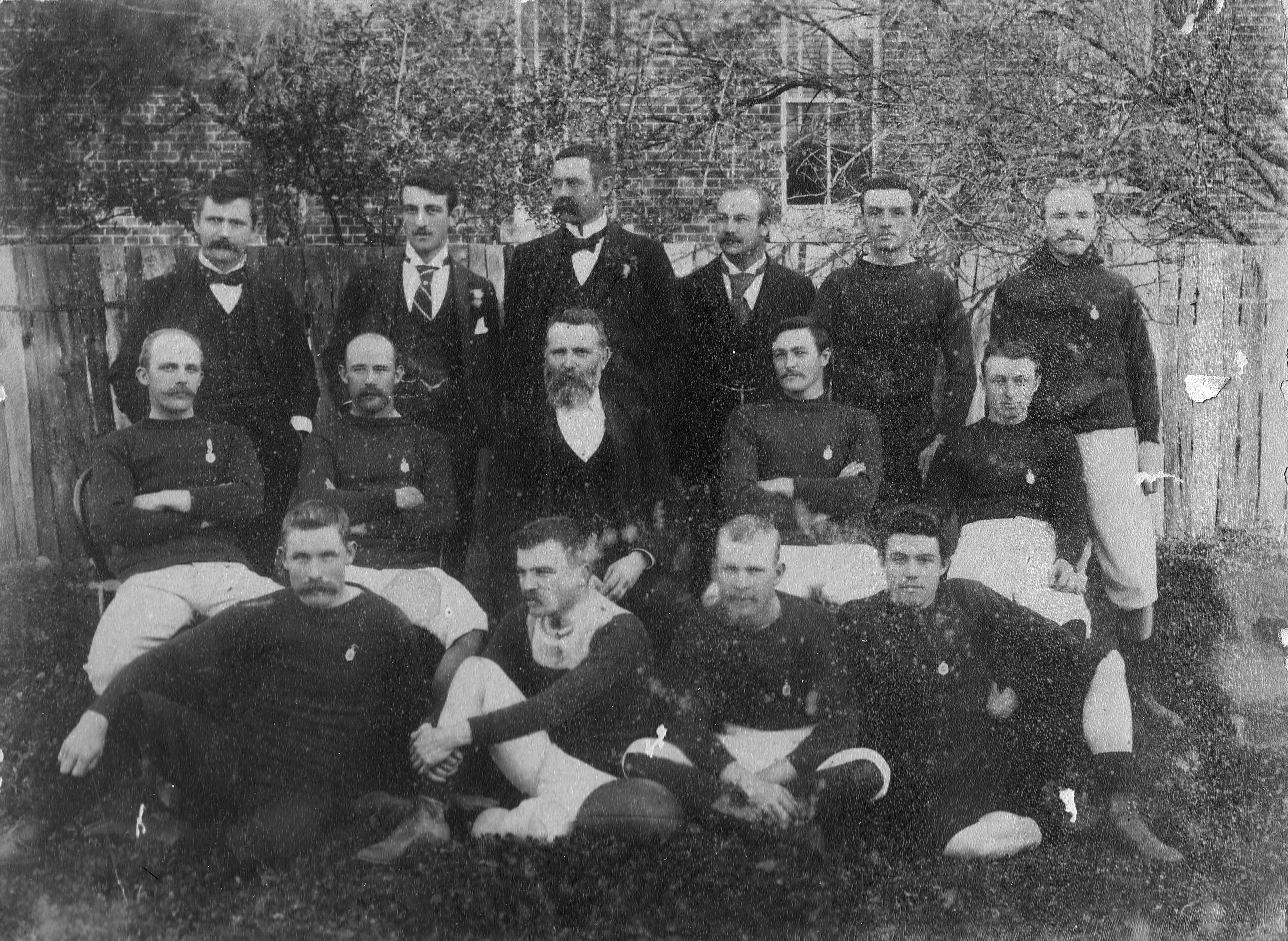
Forbes Football Premiers. Victor is pictured far right, front row.
In January the following year the rest of the Ratten family also relocated to Forbes. George Ratten became principal of the Lachlan College, but it was a stop-gap measure while he underwent training to enter the church. In September he was ordained by the Bishop of Bathurst at the city’s All Saints’ Cathedral. He was appointed curate of the local Anglican church at Forbes a month later. Whether he had a true ‘calling’ would ultimately come into question, but joining the ministry meant security for his family. It also provided a similar status in the community to that he had enjoyed as head of a private college,
Victor’s time in the town was brief. Working as a bank clerk was never going to challenge him intellectually or fulfil his aspirations. On June 10 the Western Champion reported that he had severed his connection with the Union Bank. He received a farewell gift from officials and their best wishes; not just for the future but for ‘bon voyage’.
It is surprising that nothing more was said about this impending journey, especially as Victor’s plan was, well… mind boggling. He and a companion planned to cycle around the world.
The boys could well have been inspired by Victorians George Burston and Harry Stokes. Several years earlier the pair had completed a word tour covering 10,000 miles in 14 months on Australian built penny-farthings. There were extensive write-ups of the trip when they returned in 1889. It was just the sort of thing to appeal to Victor; escape from his humdrum life in Forbes, adventure and the prospect of public acclaim.
No fund raising was reported and no mention of the complex logistics involved. His father was uncharacteristically silent, probably viewing the whole idea as foolish and ill-considered. There was just one mention of the ambitious plan in the press;
On June 24 Messrs D. Campbell and V.R. Ratten , two cyclists from Forbes, start from Sydney on a bicycle tour around the world. (The Australasian Saturday 11 June 1898.)
The Campbell mentioned is a bit of a mystery. The most likely candidate is a fellow called Dal. G. Campbell. He was from Wyalong, south of Forbes , but was a noted cyclist and footballer. He contributed regularly to local newspapers, and a journalistic talent would have been very handy for publicity. He was around the same age as Victor and later served in the Boer War.
Including sea passages, the boys expected to cover about 34,000 miles, three times that of Burston and Stokes. At least bike design had progressed beyond the old ‘high wheelers’.
Unfortunately, any misgivings the Rev. Ratten may have had were justified. The grand tour was aborted before a single progress report was published. What happened and how far the pair cycled is a mystery, but Victor was back in Forbes by early July.
Returning home after such a loss of face must have been unbearable, but worse was to come. On July 15 local butcher Richard Crollick parted Victor from his travelling wardrobe of three suits by false pretenses. A warrant was issued for his arrest, but Crollick had decamped to Sydney with the goods, valued at ten pounds.(NSW Police Gazette August 1899)
A chastened Victor was soon back in the ‘big smoke’ himself. He looked about for a profession with decent prospects, something suitable for a personable young man with a good education. He chose to become apprenticed to a dentist. One obstacle was that a premium had to be paid, which could be from 50 to 150 pounds depending on the prestige of the dental practice. Ultimately, instruments. stock and equipment would also have to be purchased. Perhaps he used some of his ‘bicycle tour’ stake.’ The normal period served was about three years, but Victor was a young man in a hurry.
For someone without capital or a university education, dentistry provided a viable option. At the time, dentists were unregistered in New South Wales. A degree of expertise was required to satisfy and retain patients, but no formal qualifications were necessary.
Victor would be self employed. It was a path to more wealth and status than toiling as a country bank clerk could ever provide.
By the time he was ready to set up a practice his parents had moved to another Central Western gold town; Wyalong. The mine at West Wyalong was the colony’s most productive field, but when George Ratten arrived, All Saint’s parish was in a serious state of decline. The rectory was a mean building of just three rooms plus a kitchen. The church was a draughty wooden building scarcely big enough to hold its dwindling congregation However, as a former schoolmaster the Rev. Ratten had a lot offer and it wasn’t long before his energy and enthusiasm began to turn things around.
Due to the failure of Parkes College, George’s personal circumstances were so reduced that a subscription was organized to buy a sulky, so that he could visit parishioners in outlying areas.. There was also a building fund, to improve the rectory by the addition of a study, dining room and reception room.
As summer approached and residents were planning for Christmas, there was a devastating event that virtually obliterated West Wyalong’s main street.
On the night of Wednesday, November 30, fire broke out in a commercial laundry. There was no water available and the wooden and corregated iron buildings exploded like fire crackers By morning, 22 businesses had been either consumed by fire or pulled down in an effort by residents to stop the flames spreading. The list of destroyed buildings included the Gladstone Hotel, the assay office, the Bank of New South Wales, two refreshments rooms, the jewellers, the stationers, two plumber’s shops,, two saddlers shops. a general store, the boot shop, the bicycle shop and one of the town’s dentists.

Shocked locals surveying the devastation.
It was into this physically and psychologically scarred community that Victor arrived, full of youthful enthusiasm, charm and ambition
Just before Christmas the local paper reported that the Reverend Ratten’s eldest son was about to leave Sydney with the intention of setting up a dental practice. It had been only sixteen months since Victor had left Forbes, but when his first advertisement appeared he announced that he had been the ’associate’ of a Dr Cohen, giving the impression that the relationship had been a partnership rather than a very brief apprenticeship. The omission of a first name or initial may have been deliberate. Did Dr Cohen even exist? No dentist by that name appears in Sydney’s Sands Directory for 1900.
A brief, humorous paragraph appeared in the Wyalong Star (Friday 5 January 1900)
By an advt. which appears in this paper, I observe we have a ‘resident’ dentist in the field. Sufferers from that agony maker, sleep disturber, and painful companion, Demon Toothache, can now be accommodated at any time and ‘Ave ‘em out’ – that’s about the only cure I know of. As Mr Ratten is the son of a local resident he will doubtless secure a fair share of local patronage.
Inferring that Victor would be West Wyalong’s first resident dentist infuriated established practitioner Dr E. Caspersonn. The editor hastily tried to make amends;
I inadvertently did an injustice in last week’s ‘snapshots’ to a well-known townsman. In stating that we now had a resident dentist on the field, in my ignorance, I forgot that we have had a ‘resident dentist’ amongst us for years. I refer to Dr. Caspersonn,of Main Street, West Wyalong. Dr Caspersonn also has the latest and most scientific appliances used in dentistry. Having done the injustice, I am glad to have the opportunity of making the amends honourable as fr as it lays in my power.
Caspersonn was soon feeling threatened by the young interloper. His own advertisements pointedly stated that he was the only dentist in the area who had gone through a proper course of training. He claimed to be a Doctor of Dentistry, having graduated from the impressive sounding Philadelphia Dental College and Hospital of Dental Surgery.
Victor had two important advantages over his competitor. One was an understanding of human psychology. His very first advertisement was headed PAINLESS DENTISTY.
The second advantage was his father, who promoted his son at every opportunity At Wyalong, Victor would attend patients at the rectory. At West Wyalong he set up premises in the main street, next door to Reay’s the chemist.
His ambition was evident almost immediately. Within six weeks Victor was advertising for an ‘educated youth’ to learn surgical and mechanical dentistry. (February 9 The Wyalong Star and Temora Barmedman Advertiser) Applicants had to be prepared to pay a premium for the dubious privilege of being trained by their barely proficient employer!
Admittedly, patients at Mr Ratten’s new dental practice had no complaints about their treatment. By the winter of 1900 he had established a good reputation. No doubt his sporting prowess helped, as well as his father’s position as a hardworking vicar.
Meanwhile Victor’s brother Aubrey had left Australia as one of the NSW Citizens’ Bushmen, for service in the South African Boer War. They were an elite group; physically fit, accurate shots and fine riders. George Ratten had reason to be proud of his sons.
By mid 1900, the town was well on the way being reconstructed after the fires, The first Post Office had been built and an application approved for a telephone exchange. Best of all, discussions were underway to have the rail line brought forty miles from Temora.
Although Wyalong was the original, surveyed town, the availability of water at West Wyalong had meant that a tent city grew up around the gold diggings and miners were reluctant to move the 5km (3 miles). Permanent dwellings were established and soon West Wyalong had overtaken the older settlement as the commercial centre.
There was an amusing account of the bitter rivalry between the two towns published in Sydney’s Daily Telegraph on August 11. The Minister of Works, Mr O’Sullivan, had just visited, giving his assurance that the first sod would soon be turned on the long anticipated rail extension. The contentious issue was, where would the railway station be located?
Meanwhile, the future looked bright for young Victor Ratten.

Pauline
Just a comment on this article, you have list Sir Henry Parkes as Prime Minister. To my uncertain knowledge he passed away before Australia was federated and became a nation.
Thanks for your interesting posts.
Bill
Oh yes, silly me. Thanks so much Bill.